Case study: +388% Google clicks for an online jewellery shop in six months
A family-run jewellery shop up against big e-commerce sites and the brands' own websites. I didn't compete on page count. I used the data only a real shop has. Here is what I did and where it grew, not just on the blog.
 Adrian Gramada · Updated November 26, 2026 · 7 min read
In short
An Italian multi-brand jewellery shop, with a physical store and an online shop, was getting about 1,600 clicks a month from Google in April 2026. From May I fixed the technical basics, set up a fixed method for content built on the real catalogue, and decided page by page whether to improve a category or write a guide. From April to October Google clicks grew 388% and, in web search, the average position went from 10.8 to 6.8. Leaving the guides out, the site still grew 121%. From 18 October to 17 November, organic search brought in 303% more revenue than in the same period of 2025.
Who is the shop and what was the problem?
It is an Italian multi-brand jewellery shop run by a family, with a physical store and an online shop. It sells watches and jewellery from brands people search for a lot. The name stays private: I show the data with the shop's consent.
Online it competes with two bigger rivals. Large jewellery e-commerce sites have thousands of products and big budgets. The brands' own sites start ahead on searches for their products.
Where did I start from?
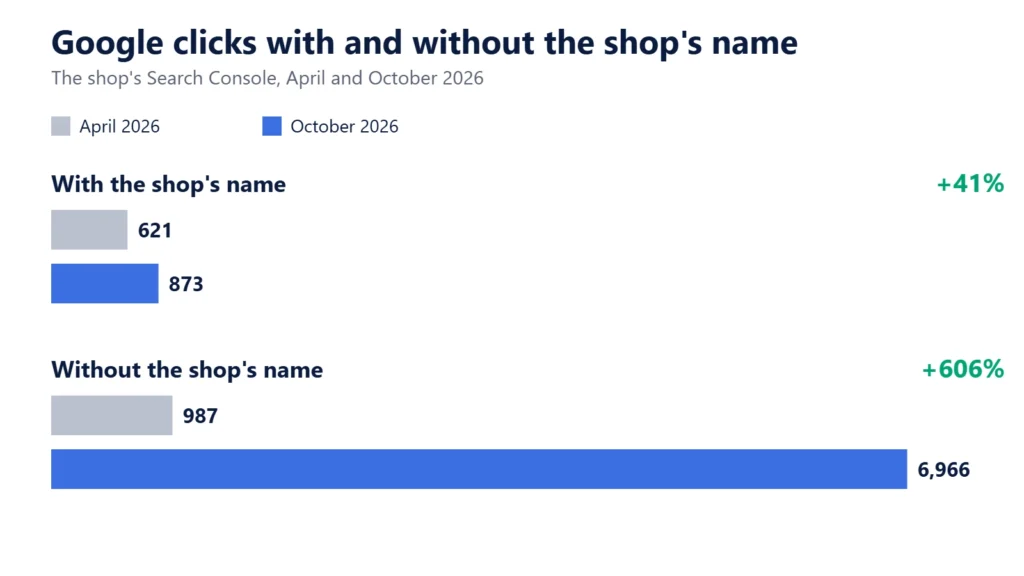
I started in May 2026. In April, 39% of Google clicks came from people already searching for the shop's name. The site did not answer the questions people ask before buying: how much it costs, which one to choose, what size to get, what to give as a gift.
I could not beat the big sites on page count, so I went for better data. A real shop knows things a big site doesn't write: the real catalogue prices, the sizes, what customers actually choose at the counter.
What did I do?
1. The technical basics (May–July 2026)
- A full technical audit: titles, meta descriptions, duplicate pages, server errors, canonicals.
- An analysis of competitors and of the shop's most important departments.
- Product structured data fixed: the product name was missing and the description was encoded twice.
- Images on the CDN: in one whole category, 79% were in the wrong format. We fixed them.
- An author box: who writes and why they know the subject.
- One rule: nothing gets published until catalogue data and images have been checked product by product.
2. A fixed method for content (from June 2026)
I build every guide the same way:
- I start from people's real questions and from what is already on Google's first page;
- I take the products from the shop's real catalogue, with prices and features;
- I add comparison tables and product cards inside the article;
- I add 12 FAQs with structured data;
- I make the cover image with a real product from the shop;
- I deliver the HTML ready to paste into the shop's back office.
I work in topic groups: watches by price range and type, jewellery (sizes, prices, meanings), gifts by person and occasion. The plan is two pieces a week until February.
3. Category or guide?
A rule I took from looking at Google: if the first page shows only category pages, I don't write a guide. I improve the category text and add FAQs, because Google would not show a guide for that search.
How much did Google traffic grow?
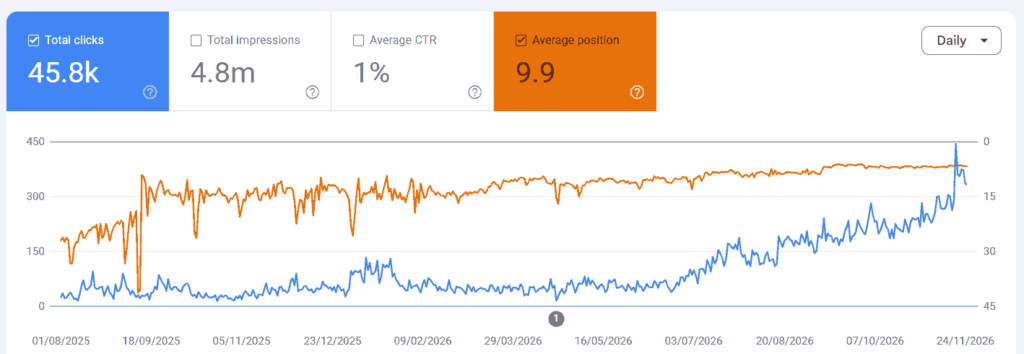
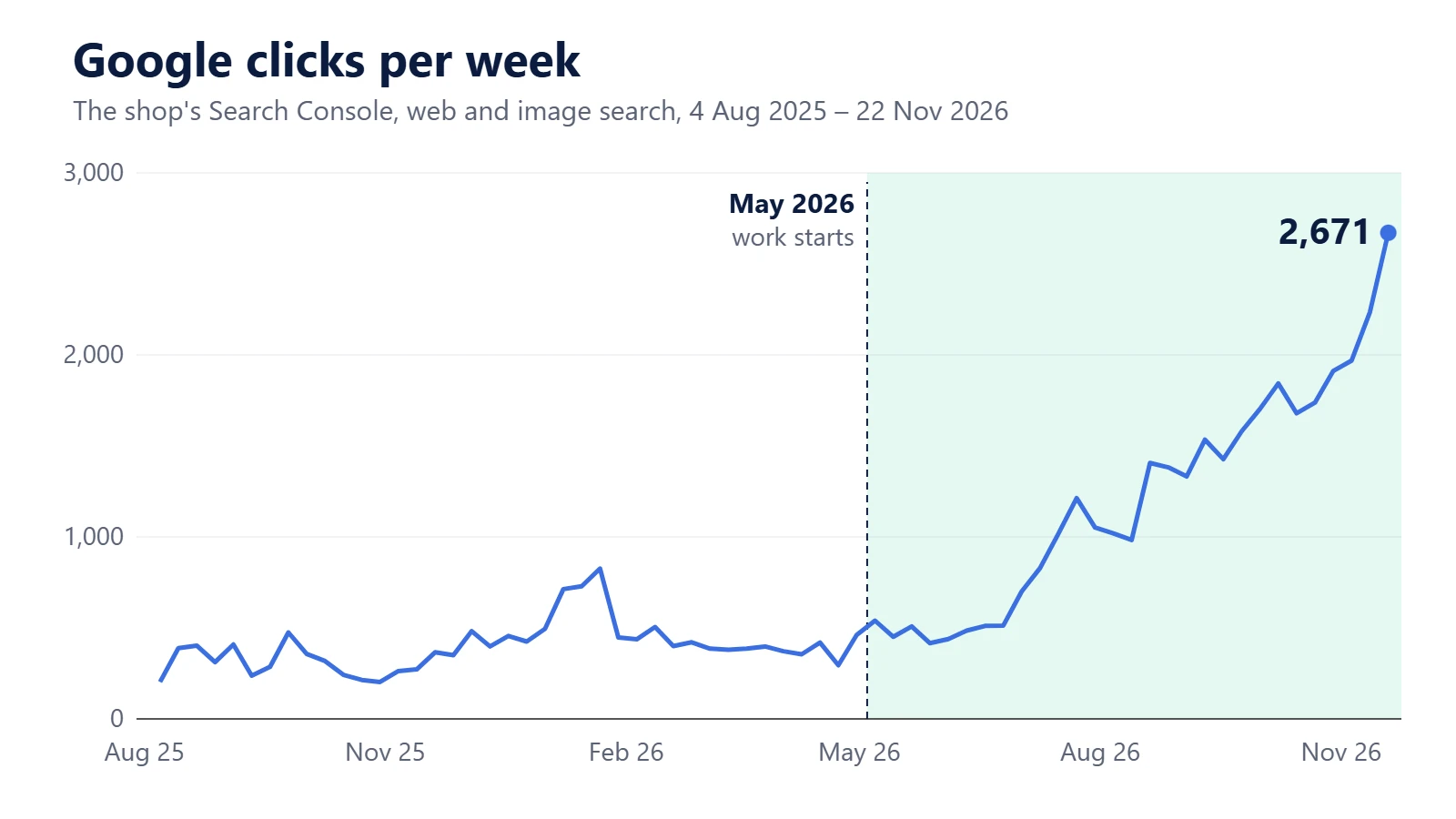
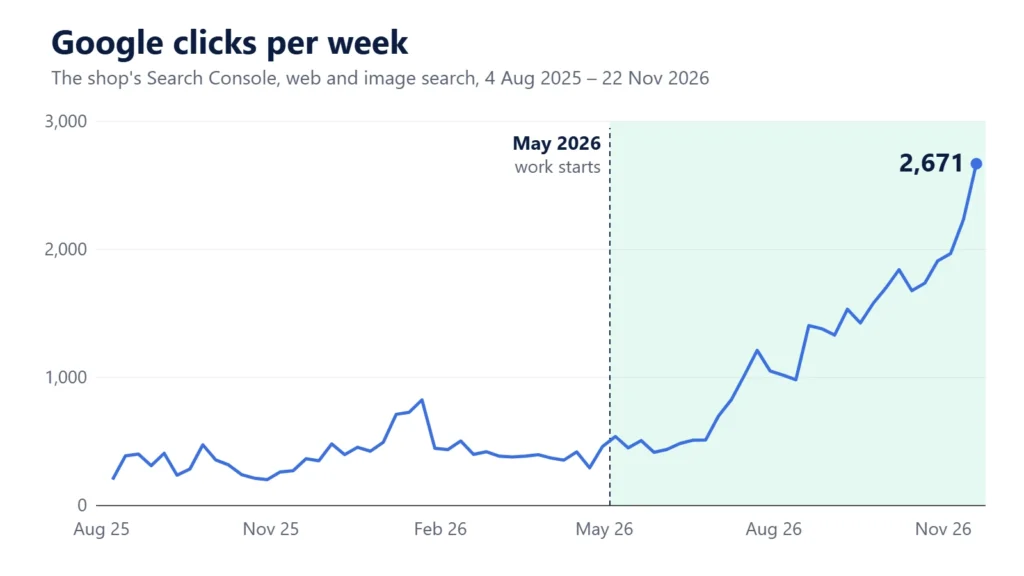
In April 2026 the shop got 1,608 clicks a month from Google, across web search and Google Images. In October it got 7,839, 388% more. In web search the average position went from 10.8 to 6.8, from the bottom of the first page to the middle.
| Month | Google clicks | April 2026 = 100 |
|---|---|---|
| April 2026 | 1,608 | 100 |
| May 2026 (work starts) | 2,097 | 130 |
| June 2026 | 2,137 | 133 |
| July 2026 | 4,361 | 271 |
| August 2026 | 5,238 | 326 |
| September 2026 | 6,399 | 398 |
| October 2026 | 7,839 | 488 |
| November 2026 (1–25) | 8,366 | 520 |
By 25 November the month was already 7% ahead of October, with Black Friday and Christmas still to come. The week of 16 to 22 November was the best ever, with 2,671 clicks.
Was it only the blog that grew?
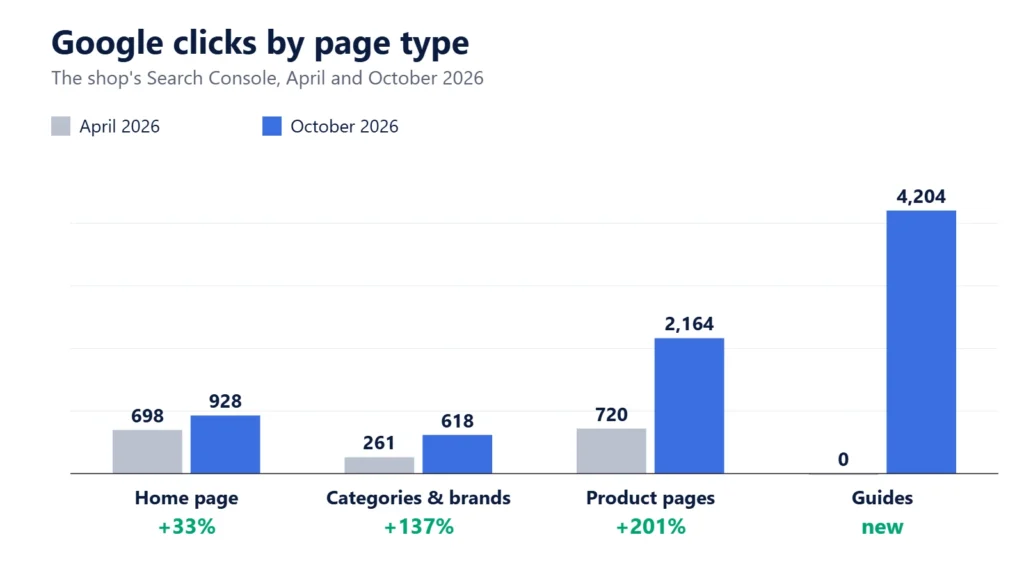
No, and this is the part I care about most. The guides are new and brought 4,204 clicks in October. But even without them the site grew 121%, from 1,679 to 3,710 clicks a month, counting only the home page, categories and product pages.
| Page type | April 2026 | October 2026 | Change |
|---|---|---|---|
| Product pages | 720 | 2,164 | +201% |
| Categories and brand pages | 261 | 618 | +137% |
| Home page | 698 | 928 | +33% |
| Guides (new since June) | 0 | 4,204 | new |
Product pages are the pages that sell, and their clicks tripled. In web search, those getting at least one click from Google went from 401 to 852. These are the pages where I fixed structured data and images, and the ones the guides link to with product cards inside the articles.
Categories and brand pages grew 137%. There I worked on the text and the FAQs instead of writing articles Google would not have shown.
And new people are arriving. From April to October, clicks from searches without the shop's name went from 987 to 6,966 (+606%). Clicks from searches with the name went from 621 to 873 (+41%).
Did sales go up?
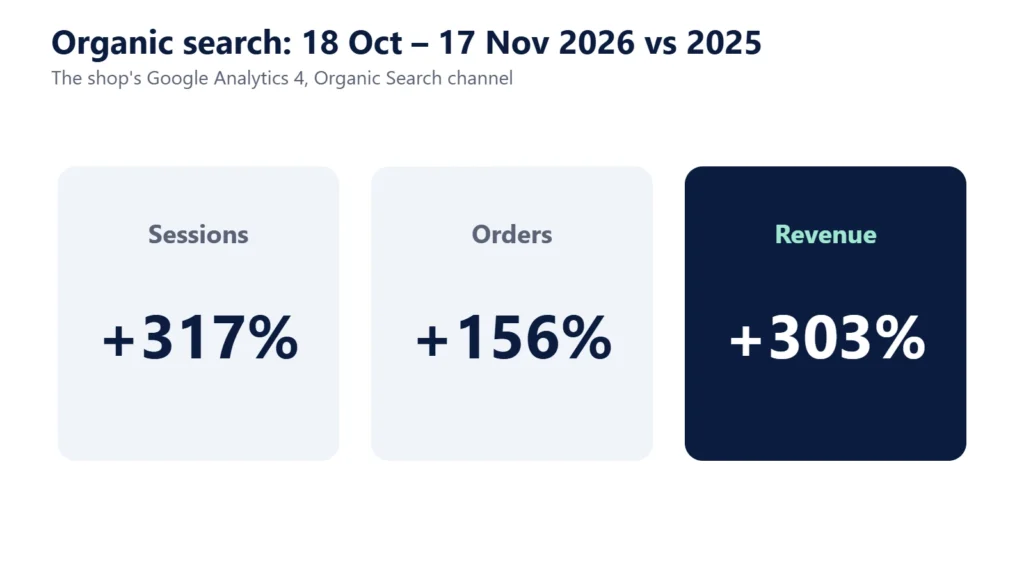
I compared 18 October to 17 November 2026 with the same period of 2025, in the Organic Search channel of Google Analytics 4:
| Organic search | Change vs 2025 |
|---|---|
| Sessions | +317% |
| Orders | +156% |
| Revenue | +303% |
The absolute order numbers stay private and are still small, so the percentages move a lot from month to month. The next step is getting more of the people who arrive through the guides to buy.
What don't I count?
- No comparisons before August 2025. Google Analytics tracking changed around then and the numbers are not comparable.
- Search Console clicks include web search and Google Images. The screenshot and the average position are web search only.
- Impressions grew faster than clicks. On some very popular jewellery searches, part of the clicks go to Google's AI answers and product carousels.
- Organic search only. Since October I also work on ads and email; they are not counted here.
If you run an online shop, where should you start?
- Check in Search Console how many clicks come from searches with your shop's name. If it is a lot, Google mostly sends you people who already know you.
- Collect the questions customers ask you in store, on the phone or in chat. That is your content plan.
- Write with your own products and real prices, not generic descriptions.
- Before writing, look at Google's first page: if it shows only categories, work on the category.
- Check product pages before anything else: structured data, images, names. They are the pages that sell.
If you want me to look at your shop's data, message me on LinkedIn and I'll tell you where I would start.
Another case study, on one of my own sites: how curarebarba.it is recovering after a Google core update.
Data: the shop's Google Search Console and Google Analytics 4, with its consent, read on 26 November 2026.
Frequently asked questions
How long did it take to see results?
I started in May 2026. By July Google clicks were already 2.7 times April's, and they grew every month until October. Growth continued in November.
Was the growth only thanks to the blog?
No. Without the guides the site grew 121%: product pages +201%, categories and brand pages +137%, home page +33%. The guides come on top and bring new people to products and categories.
Why work on categories instead of writing articles?
Because for some searches Google shows only category pages on the first page. An article would not be shown there, so it is better to improve the category text and add FAQs.
Does this work for a small online shop?
This is a family shop, not a big site. The advantage it used is the one only a real shop has: prices, sizes and the choices real customers make, which big sites don't write. Results depend on each shop's market and starting point.
Is the Search Console screenshot real?
Yes. It is the shop's Search Console Performance report, cropped to remove the domain. The shop's name stays private.
Want to know if AI engines cite your site?
CiteProof asks your customers' questions to ChatGPT, Perplexity, Gemini, Claude and Google AI Overview, then tells you what to fix.
Run a free 5-engine scan →